

First home buyer stamp duty and grants in regional Victoria: what applies in Drouin and Warragul in 2026

Say you’re weighing up a $550,000 house in Drouin against a $650,000 townhouse in Pakenham. Same weekly repayment, give or take. The general wisdom is that regional Victoria offers extra benefits for first home buyers, so the Drouin house looks like the better financial move.
Half of that is right. The Drouin purchase will cost you roughly $11,000 less in stamp duty. But the reason has nothing to do with regional benefits, and understanding that matters before you sign anything.
Here’s what applies to first home buyers across Drouin, Warragul, Pakenham and the broader corridor in 2026, what has changed in recent years, and where the regional Victoria distinction still genuinely matters.
All figures in this article were verified against the State Revenue Office Victoria website on 20 April 2026.
The $20,000 regional grant is gone
The most common misconception we hear from corridor buyers is that regional Victoria still gets a larger First Home Owner Grant than metro Melbourne. It doesn’t.
The $20,000 regional FHOG ended on 30 June 2021. From that date, all Victorian first home buyers of new homes have received the same $10,000 grant, regardless of where in the state they buy. A buyer in Drouin gets exactly the same grant as a buyer in Pakenham or Point Cook.
The same goes for state stamp duty. First home buyer rules under the Duties Act 2000 apply identically across Victoria. No concession is unique to regional postcodes, and hasn’t been for almost five years.
Where regional Victoria still matters: the federal 5% Deposit Scheme cap
One piece of the picture genuinely is regional, and it’s the one that catches buyers out.
The federal 5% Deposit Scheme (formerly known as the Home Guarantee Scheme) allows eligible first home buyers to purchase with a 5% deposit without paying Lenders Mortgage Insurance. Since 1 October 2025, income caps have been removed and places are unlimited, which has made the scheme materially more useful than it was under the previous quota system.
But the scheme has property price caps that vary by location, and here the regional versus metro line does bite:
- Melbourne and Geelong, which includes Pakenham, Officer, Clyde North, Berwick and Cranbourne: $950,000.
- Rest of Victoria, which includes Drouin and Warragul: $650,000.
For a first home buyer looking at a $700,000 property, a Pakenham address is inside the federal scheme’s cap. A Warragul address is above it. That doesn’t stop you buying. It does mean you will either need a larger deposit or you will pay LMI on top of everything else.
The federal Help to Buy shared equity scheme, which opened to applications in December 2025, operates on similar regional boundaries with equivalent effects.
How the numbers look: Drouin versus Pakenham examples
The table below runs four realistic scenarios through the 2026 rules. All assume you’re an eligible first home buyer and the property will be your principal place of residence.
| Scenario | Stamp duty payable | First Home Owner Grant | 5% Deposit Scheme eligibility |
|---|---|---|---|
| $550,000 established home in Drouin | $0 | Not eligible (established home) | Eligible (under $650,000 cap) |
| $650,000 established home in Pakenham | approx. $11,356 | Not eligible (established home) | Eligible (under $950,000 cap) |
| $700,000 new townhouse in Warragul | approx. $24,713 | $10,000 | Not eligible (above $650,000 regional cap) |
| $700,000 new townhouse in Pakenham | approx. $24,713 | $10,000 | Eligible (under $950,000 cap) |
The temporary off-the-plan concession until October 2026
One more piece worth knowing about, especially if you’re looking at a new development in Clyde North, Pakenham, Officer or one of the newer estates around Drouin.
Victoria’s temporary off-the-plan stamp duty concession was extended in the 2025-26 state budget and runs until 20 October 2026. For contracts signed inside that window on strata apartments and townhouses with common property, stamp duty is calculated on a reduced dutiable value. That value is the land component plus any construction already completed at the contract date, not the full contract price.
For a $700,000 off-the-plan townhouse where the uncompleted construction represents $150,000, the dutiable value drops to $550,000. That brings a first home buyer below the $600,000 exemption threshold, and duty becomes zero. This concession is available to all buyers, not just first home buyers, which is unusual.
It doesn’t apply to house-and-land packages or standalone dwellings without common property. For buyers weighing up a townhouse development against a standalone new house at a similar price, the concession can meaningfully shift the numbers towards the townhouse.
What your conveyancer checks that saves you money
None of these concessions applies automatically. Each has to be claimed, which means someone has to work out what you qualify for and lodge the paperwork through the Digital Duties Form before settlement.
The common mistakes we see:
- Assuming the first home buyer concession carries across if only one partner has previously owned property in Australia. It doesn’t. Both buyers must be first home buyers.
- Missing the 12-month occupancy requirement. If you claim the concession but don’t live in the property continuously for at least 12 months within 12 months of settlement, the SRO can claw the duty back.
- Relying on a developer’s or agent’s estimate of off-the-plan dutiable value without a quantity surveyor’s report. The SRO requires documentation, not assurances.
- Not flagging FHOG eligibility early enough. For house-and-land packages, the grant is paid at the first construction progress payment, and the application needs to be in before then.
A competent conveyancer will run eligibility against every concession available, confirm the numbers before contract exchange, and flag any condition that could risk a clawback later. That work is part of what you’re paying a conveyancing fee for, and it’s worth doing carefully on first home purchases where the savings are largest.
Before you sign, confirm the numbers
The single most useful action: before you sign a contract of sale, run the exact purchase price through the State Revenue Office calculator and have your conveyancer confirm which concessions apply. Not the day before settlement. Before you sign.
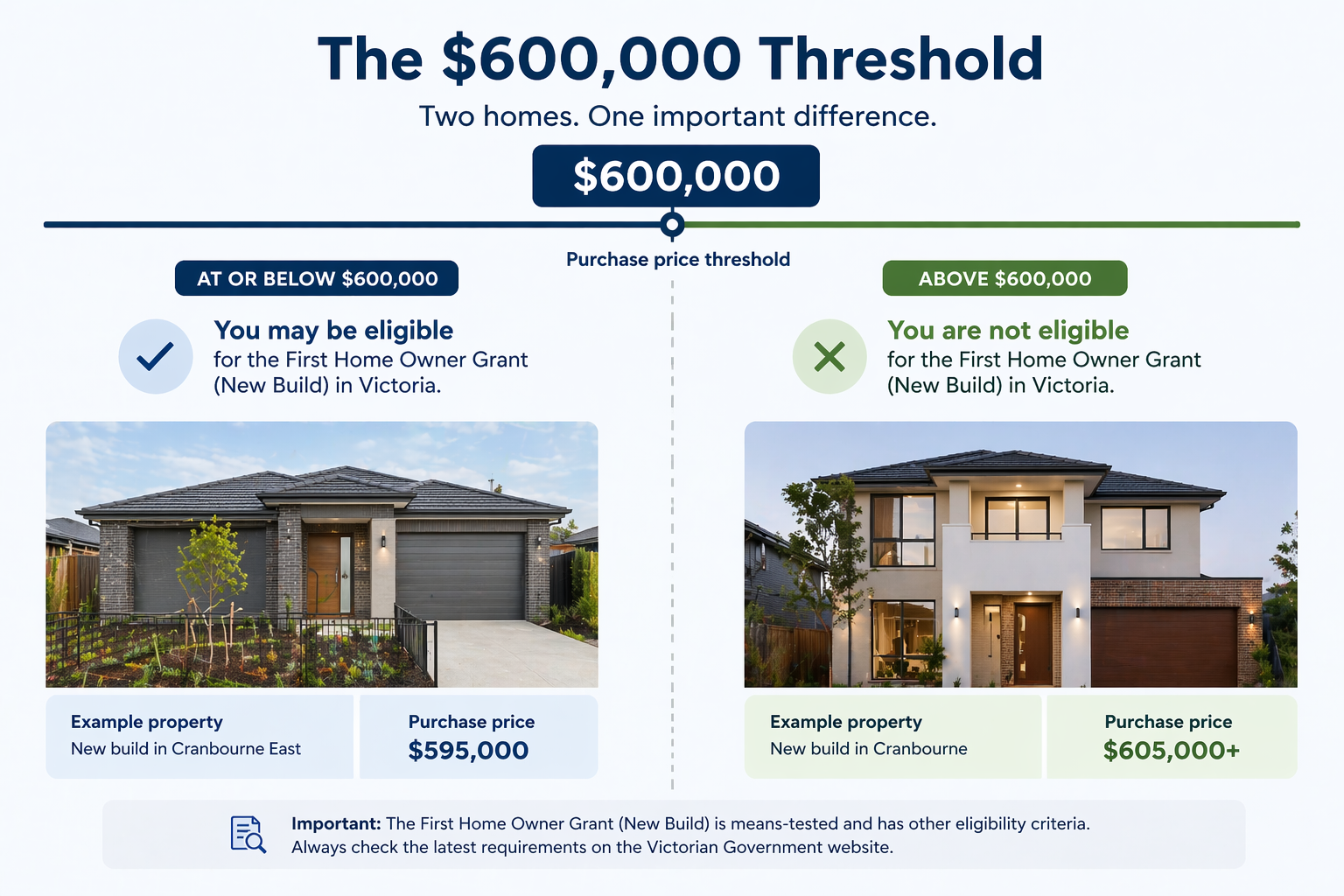
Concessions are locked in at the contract date, not the settlement date. A property priced at $605,000 with a small reduction to $600,000 during negotiation can swing the stamp duty bill by several thousand dollars. That’s not a settlement conversation. It’s a negotiation conversation, and the numbers need to be at your fingertips when you’re making the offer.
Victorian stamp duty thresholds don’t index automatically. They’ve been the same since 2017 while median prices in Drouin, Warragul, Pakenham and the rest of the corridor have climbed. That creates opportunities for buyers who negotiate with the thresholds in mind, and it creates unpleasant surprises for those who don’t.
If you’re looking at property in Drouin, Warragul or anywhere between Berwick and Warragul and want the numbers checked against your specific circumstances, Conveyancing Today can run a free quote and pre-contract review. You’ll know exactly what you’re facing before the deposit is committed.
This article provides general information only and is not legal or financial advice. Stamp duty thresholds and First Home Owner Grant rules change with Victorian state budgets; all figures in this article were current as of 20 April 2026. For advice specific to your situation, consult a qualified conveyancer or financial adviser.