

Rural property conveyancing in West Gippsland: water, septic, access and bushfire checks

Information current as at 6 May 2026.
A Melbourne couple recently signed a contract on a 12-acre block north of Drouin. They had bought property before, both times in suburban Melbourne. This contract felt different. The vendor statement listed two parcel numbers instead of one. The agent mentioned “stock and domestic” water rights without explaining what those covered. The property report flagged BMO. And the access track ran across what looked, on the title plan, like a sliver of unmade road reserve.
That is the moment many rural buyers realise something the residential market never prepares them for. Buying acreage in West Gippsland is not buying a suburban block with more grass. The conveyance has different checkpoints, different risks, and a different list of authorities to deal with. This article walks through the checks that matter most for rural property conveyancing in Victoria, anchored in the corridor we know best: Baw Baw Shire and the eastern Cardinia rural pockets.
How rural property conveyancing in Victoria differs from the suburbs
The legal frame is largely the same. A Section 32 vendor statement is still required under the Sale of Land Act 1962 (Vic), the contract still includes cooling-off rights, and settlement still happens through PEXA. What changes is the land itself and the rights and obligations attached to it.
A typical residential block in Officer or Cranbourne North has a single title, mains water, sewered toilets, sealed road access, no significant natural hazard exposure, and council infrastructure within metres of the boundary. A 20-acre lifestyle block near Neerim South can have none of those things. The same checkpoints look very different across property types:
| Checkpoint | Suburban (Officer) | Lifestyle block (Drouin) | Larger acreage (Neerim South) |
|---|---|---|---|
| Water | Reticulated mains | Tank, often plus bore | Tank, bore, dam, possible licence |
| Sewerage | Council sewer | Septic or AWTS | Septic, AWTS or reedbed |
| Access | Sealed road, council kerb | Sealed road, private gravel drive | Unsealed track, often crosses other land |
| Bushfire status | Usually no overlay | BMO often applies | BMO almost certain |
| Number of titles | One | Often two | Two or three |
The conveyance has to address every one of those differences. A residential conveyance does not.
Water rights and supply
Where the property gets its water is the first question to answer, and the answer is rarely as simple as “tank and bore.”
- Tank, bore, dam, spring, irrigation channel, or a mix. Each comes with different ongoing obligations. Tank-only properties depend on roof catchment area and rainfall reliability. Bore properties depend on aquifer health and the bore’s condition. Dam-fed properties may rely on a permit that has lapsed.
- Stock and domestic rights. Under section 8 of the Water Act 1989 (Vic), landowners have a statutory right to take water for domestic and stock purposes from a waterway that flows through, or borders, their property. That covers household use, watering pets, watering livestock, fire prevention, and a kitchen garden. It does not cover commercial uses such as dairies, piggeries, feedlots, or the irrigation of crops for sale.
- Bores and Bore Construction Licences. Bores must be registered with Southern Rural Water, the rural water corporation for southern Victoria. New bores require a Bore Construction Licence before any work begins. If the property has an unregistered or undocumented bore, that is the buyer’s problem after settlement.
- Surface Water Licences. If the property takes water from a waterway that does not run through or border the land (for example, a waterway separated from the property by a public road or another title), a Surface Water Licence may be required. These are issued by Southern Rural Water under section 51 of the Water Act 1989.
- Dam permits. Older farm dams are often unpermitted. Newer dams above the relevant capacity threshold need a Works Licence. Whether a dam is documented matters more than how full it is.
- Irrigation water shares. Properties on declared irrigation systems may carry a water share or licensed entitlement that transfers separately from the title. Verify which transfers automatically and which require a separate transfer through the Victorian Water Register.
Southern Rural Water can confirm the status of bores and surface water licences in the West Gippsland area. The Victorian Water Register holds the records for water shares and licensed entitlements. A copy of the certificate of title alone does not tell the buyer whether the water rights they were promised will arrive with the property.
Septic and onsite wastewater systems
Most rural blocks in West Gippsland sit outside the reticulated sewer network. Sewage is managed onsite, and the system becomes the buyer’s responsibility from settlement onwards.
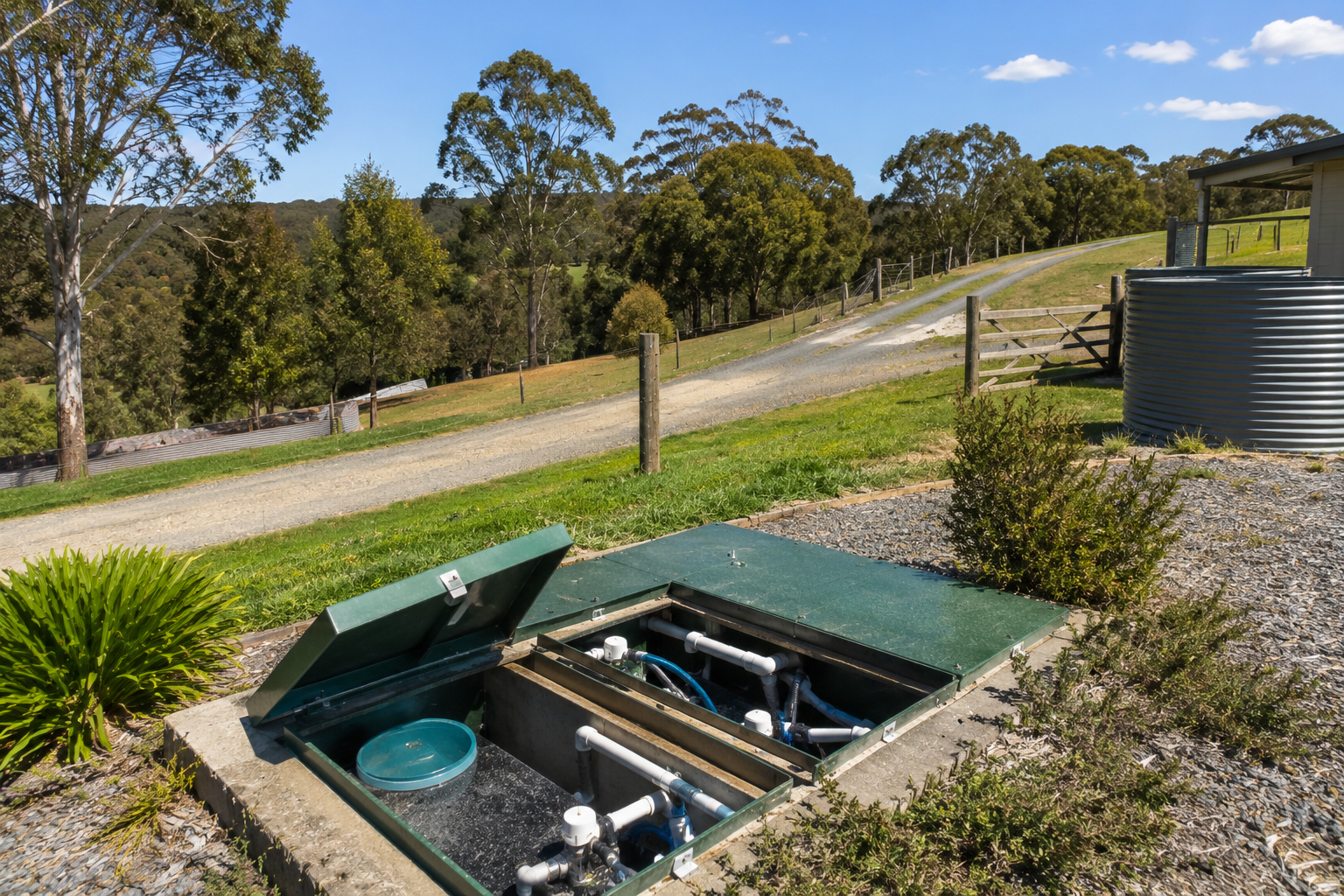
- What system is in place. Septic tank with absorption trench, AWTS (aerated wastewater treatment system), reedbed, or composting toilet. Each has different compliance and maintenance requirements. AWTS units need regular servicing by an accredited servicer. Absorption trenches need correct soil and setbacks.
- Council Permit to Install or Alter. Onsite wastewater systems treating up to 5,000 litres per day require an A20 permit issued by the local council under the Environment Protection Act 2017 and the Environment Protection Regulations 2021. In the Drouin and Warragul catchment, that permit is issued by Baw Baw Shire. Confirm the permit exists and the installed system matches what was approved.
- Servicing records. AWTS systems require quarterly servicing in most cases. Missing servicing records are a real risk. A non-compliant system can require replacement at the buyer’s cost, and replacement budgets often start in the tens of thousands.
- EPA guidance. EPA Victoria’s Guideline for Onsite Wastewater Management replaced the earlier Code of Practice (Publication 891.4). Local councils administer day-to-day permits and inspections. The applicable Australian Standard is AS/NZS 1547.
- Setback distances. Wastewater systems must sit a minimum distance from bores, dams, waterways, neighbouring boundaries, and the dwelling itself. Non-compliant setbacks become the buyer’s problem when the next upgrade or alteration triggers a new permit.
If the system is older than fifteen years and has no recent inspection report, a pre-purchase inspection by a licensed plumber or environmental health professional is money well spent.
Access, easements and multiple titles
Rural access can look fine on a sunny weekend visit and turn into a different problem in mid-July rain.
- Title boundaries against the actual road. The legal point of access on the title plan must match the physical access point on the ground. Long unsealed driveways often cross unmade road reserves, crown land, or neighbouring titles without a registered easement.
- Multiple titles on one property. Many lifestyle blocks comprise two or three certificates of title. Each must be searched, and each can carry different encumbrances. A common pattern in the Drouin to Trafalgar belt: one title for the house and curtilage, a second for the paddock land, with separate covenants on each.
- Carriageway easements. If the only way to reach the property crosses a neighbour’s land, a registered right of carriageway must be on title. A handshake arrangement with the previous owner does not transfer.
- Crown land and unmade roads. Where the property borders crown land or an unmade road, confirm whether access requires a licence or a right-of-way agreement. The Department of Energy, Environment and Climate Action (DEECA) administers crown land matters in Victoria.
- All-weather access. Especially in the hills behind Neerim South, Noojee, and the Strzelecki Ranges, properties accessed by gravel tracks can be cut off after heavy rain. Walk the access in wet conditions or accept the risk.
- Fire and emergency access. Properties in a Bushfire Management Overlay may need to meet specific access width and gradient standards before a planning permit for a new dwelling can be granted. That can affect plans to subdivide or build a second dwelling later.
Bushfire and planning overlays
This is the section that matters most for West Gippsland buyers. The Strzelecki foothills, the timbered country east of Warragul, and the rural-residential pockets through Bunyip, Garfield, Tynong, Nar Nar Goon, and Longwarry are extensively covered by bushfire planning controls.
- Bushfire Management Overlay (BMO). The BMO sits at clause 44.06 of Victorian planning schemes. Properties in the BMO require a planning permit for a new dwelling or major rebuild, with bushfire protection measures designed in. Permit conditions are referred to the CFA. A property in the BMO is also automatically in a Bushfire Prone Area.
- Bushfire Prone Area (BPA). The BPA triggers building regulations rather than planning controls. New buildings in a BPA must meet a minimum Bushfire Attack Level of BAL-12.5 under the National Construction Code and the Building Regulations 2018.
- Bushfire Attack Level (BAL) rating. BAL ratings under AS 3959:2018 run from BAL-LOW through BAL-12.5, BAL-19, BAL-29, BAL-40, and BAL-FZ (Flame Zone). Each step up the scale adds tens of thousands of dollars to a rebuild. If a current BAL assessment exists, get a copy. If not, commissioning one before settlement is a prudent step.
- Existing dwelling compliance. A house built before current BMO or BPA standards applied may not meet today’s bushfire construction requirements. The buyer needs to know that before settlement, not at the next insurance renewal.
- Vegetation Protection Overlay (VPO) and Environmental Significance Overlay (ESO). Both are common across Baw Baw Shire. They restrict tree clearance and can block paddock improvements, fire-break clearing, and outbuilding placement. A property with VPO and BMO together may require an environmental assessment to clear vegetation that is also a fire risk.
- Insurance availability. Some BAL-FZ and BAL-40 properties are uninsurable through mainstream providers, or insurable only through specialist underwriters at significant premiums. Confirm insurance is available and affordable before contracts go unconditional.
The Victorian Government’s free Property Report through VicPlan (mapshare.maps.vic.gov.au/vicplan) shows the planning controls on a specific address, including BMO and BPA status. The CFA directs property owners to VicPlan as the standard reference.
Other rural-specific issues to flag
A short catch-all of issues that surface less often but can still derail a settlement.
- Stock crossings and farming covenants. Some titles include neighbour rights to move stock across the property at agreed times. These are usually documented but not always.
- Aboriginal cultural heritage. Victorian land carries protections under the Aboriginal Heritage Act 2006. The Victorian Aboriginal Heritage Register, accessed by qualified heritage advisors through the Aboriginal Cultural Heritage Register and Information System, records known places and objects. For development that triggers a Cultural Heritage Management Plan (CHMP), this becomes a planning matter.
- Apiary, agistment, and sharefarming arrangements. Verbal agreements with the previous owner do not transfer. They need to be terminated, transferred, or formalised before settlement.
- Land Tax. Rural land that is not used for commercial primary production is generally Land Tax assessable. Hobby farms and lifestyle blocks rarely qualify for the primary production exemption under sections 65 to 67 of the Land Tax Act 2005 (Vic). The State Revenue Office is the relevant authority.
- Plantation timber rights. Particularly relevant to Strzelecki blocks. Previous owners may have signed long-term timber harvest agreements that bind future owners.
Before you sign: the rural property walk-through
The single most useful thing a rural buyer can do before signing is walk the property carefully, twice if possible, and once in wet weather.
Find the boundary fences and check they match the title plan. Locate every dam, bore, septic vent and pump shed. Walk the access track and note where it could become impassable. Check phone and internet signal at the house, the back paddock and the front gate. Test water pressure if the property is on a tank-and-pump setup. Open every cupboard under every sink for signs of past leaks. Look at the roof for visible damage that storm cover never replaced.
Most rural surprises surface in this walk, not in the contract.
Common questions about rural property conveyancing in Victoria
What does a rural conveyancer check that a residential conveyancer doesn’t?
A rural conveyance includes title searches across multiple parcels, water rights and entitlements, onsite wastewater permits, access and carriageway easements, planning overlays (BMO, BPA, VPO, and ESO), Crown land and unmade road access, and any farming or agistment arrangements attached to the land. A residential conveyance in a fully serviced suburb usually does not need to address any of these.
Do water rights transfer automatically when I buy a rural property?
Statutory stock and domestic rights under the Water Act 1989 (Vic) transfer with the title because they are tied to the land. Licensed water entitlements such as Surface Water Licences, Bore Construction Licences, and irrigation water shares often transfer separately and may need a transfer application to Southern Rural Water or a transfer through the Victorian Water Register. The contract should specify what transfers and how.
How do I find out if a property is in the Bushfire Management Overlay?
The Victorian Government’s VicPlan website (mapshare.maps.vic.gov.au/vicplan) provides a free Property Report showing all planning controls applying to a specific address, including BMO and BPA status. The local council can also confirm. Properties in the BMO require a planning permit for new dwellings, with bushfire protection measures designed and approved before construction.
How does Land Tax work on a hobby farm or lifestyle block?
Under the Land Tax Act 2005 (Vic), rural land used commercially for primary production may qualify for an exemption under sections 65 to 67. Hobby farms and lifestyle blocks generally do not qualify because the use is not at a commercial scale with profit-making intent. The State Revenue Office assesses each application on its merits. Buyers should expect the property to be Land Tax assessable unless an exemption is approved.
What is an A20 permit and do I need one?
An A20 permit is the council-issued permit for an onsite wastewater management system treating up to 5,000 litres per day. It is required under the Environment Protection Regulations 2021 for any new system, alteration, or replacement. In the Baw Baw Shire area, the permit is administered by the council. If the existing system has no permit on file, that is a compliance gap the buyer inherits.
How long does rural property conveyancing take in Victoria?
A standard residential conveyance in Victoria runs 30 to 60 days from contract to settlement. Rural conveyances often run longer because of the additional searches and verifications: multiple titles, water entitlements, planning overlays, Crown land matters, and onsite wastewater permits. Building extra time into the settlement period reduces the risk of having to extend at the last moment.
Can I rely on a Section 32 to disclose all rural-specific issues?
Section 32 of the Sale of Land Act 1962 (Vic) requires the vendor to disclose specific information including title encumbrances, planning controls, building approvals, water rates, and notices. It does not require the vendor to commission new reports such as a current BAL assessment, an updated wastewater inspection, or a soil capability assessment. A buyer relying solely on what is in the Section 32 may miss issues that are not legally required to be disclosed.
Buying or selling a rural block in West Gippsland
We handle rural and lifestyle conveyances across Baw Baw Shire and the eastern fringe of Cardinia Shire from our Drouin office. Get in touch before you sign so we can run the rural-specific checks early, while there is still time to act on what they show. Get a quote here.
This article provides general information only and is not legal advice. For advice specific to your situation, consult a qualified conveyancer or solicitor.