

Vendor statements that fail: the disclosure mistakes that delay Victorian settlements
Information current as at 6 May 2026.
You’ve accepted an offer on your Pakenham home. Settlement is in three weeks, the deposit is in trust, and you’re already looking at properties in Drouin. Then your conveyancer forwards an email from the buyer’s side flagging three problems with your Section 32 vendor statement. A title search dated four months ago. An owners corporation certificate that’s missing two pages. A pergola that doesn’t show up in any building permit on file.
The buyer’s conveyancer hasn’t said the word ‘rescind’ yet, but they don’t have to. You both know what’s at stake. The vendor statement you barely glanced at when you signed it now controls whether the sale closes on time, or at all.
These are the disclosure mistakes that most often cause this exact situation, and what to check before your vendor statement leaves your conveyancer’s office.
What makes a Victorian vendor statement fail
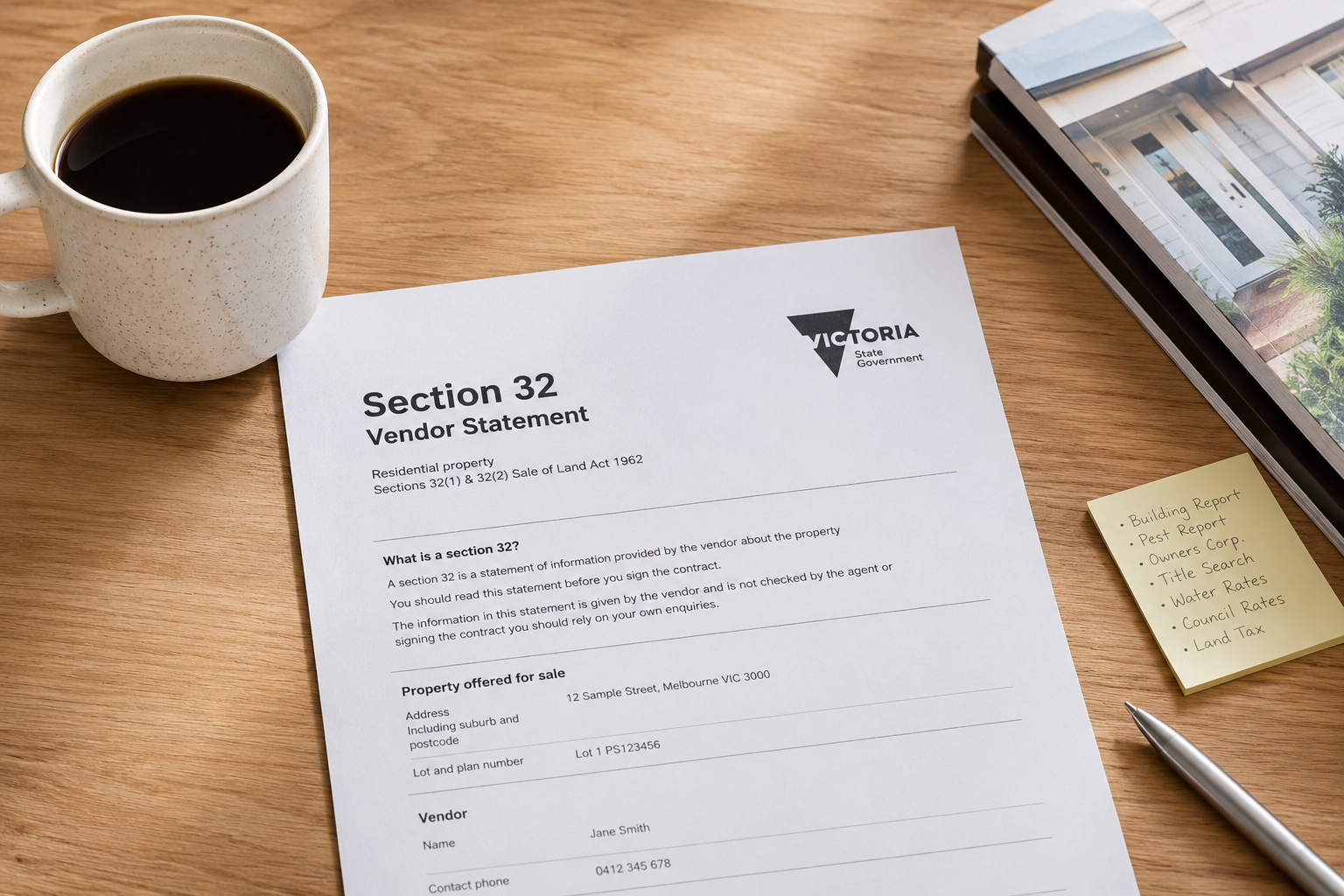
Under Section 32 of the Sale of Land Act 1962 (Vic), the vendor must give the purchaser a signed vendor statement before the purchaser signs the contract of sale. This document, often called the Section 32, must disclose specific information about the property: title details, financial outgoings, planning controls, building permits in the past seven years, owners corporation matters, services connected, and any notices or orders affecting the land.
When something material is missing, false, or misleading, Section 32K of the Act gives the purchaser a clear right to rescind (cancel) the contract at any time before they accept title and become entitled to possession. In practical terms, that means any time before settlement.
There is a defence in Section 32K(4): the vendor can avoid rescission if a court is satisfied the vendor acted honestly and reasonably and the purchaser is substantially in as good a position as if the disclosure had been correct. That defence is not a safety net you want to rely on. By the time it is argued, the sale has already collapsed and you are looking at legal costs.
The Section 32 mistakes that most often delay settlements
Across the Pakenham to Warragul corridor, the same disclosure errors keep appearing. Some are the conveyancer’s responsibility. Some are the vendor’s. Most are catchable before the document goes out.
- Outdated certificates and title searches. The information in the vendor statement must reflect the current state of the property. A title search pulled three months ago might miss a recent caveat, a new mortgage, or a transfer that has not been corrected. Council and water rate certificates need to be current to the rates year. The general rule conveyancers work to: anything older than 30 days at the date of signing is a risk that should be refreshed.
- Missing or incomplete owners corporation certificates. This is the most common townhouse and unit problem across Clyde North, Berwick, Officer and Pakenham. The OC certificate must show current fees, insurance, financial statements, and any pending special levies. A certificate that does not include the most recent annual general meeting minutes, or that misses a special levy already approved at AGM, leaves the buyer with grounds to challenge.
- Undisclosed planning overlays. Bushfire Management Overlay (BMO), heritage overlay, vegetation protection overlay, environmental significance overlay, flood overlay. The vendor must list every overlay that applies. Berwick vendors with heritage-listed homes and West Gippsland vendors selling under BMO are particularly exposed here, because the overlays trigger building and vegetation rules the buyer needs to know about before they commit.
- Building works without permits or final certificates. The pergola, the deck, the carport conversion, the second bathroom added in 2019. Any building permit issued in the past seven years must be disclosed, along with the occupancy permit or certificate of final inspection where applicable. If the vendor was an owner-builder, an Owner Builder Defects Report less than six months old and proof of builder’s warranty insurance are also required. Works that needed a permit but never got one are the highest-risk version of this mistake.
- Outstanding notices or orders. Notices from Cardinia Shire, Casey Council, Baw Baw Shire or any other authority. Building orders, fencing notices, compulsory acquisition proposals, environmental orders. Vendors regularly forget about a notice from two or three years ago that was never formally resolved.
- Misstated land use, zoning, or services. Particularly common on rural-residential and farm-zoned properties around Drouin and Baw Baw Shire. The Section 32 must state what services are connected and what is not. Mains water, town sewerage, septic, tank water, gas: each has to be accurate. A property described as connected to mains sewerage when it runs on septic is a misrepresentation, not a typo.
- Easements and restrictive covenants buried in the title. Drainage easements, sewerage easements, building envelope restrictions, single-dwelling covenants. These appear on the title but are easy to overlook when the Section 32 is being drafted. The buyer’s conveyancer will find them. Better to disclose them clearly with the relevant instrument attached.
- Verbal representations from the agent that don’t match the Section 32. Agents sometimes tell buyers things at opens that are not in the disclosure document: that the rear shed has a permit, that the property is connected to gas, that the boundary fence sits on the title line. If those statements are wrong and the Section 32 is silent, the gap gives the buyer grounds to renegotiate or pull out.
The mix of risk shifts depending on the type of property:
| Property type | Highest-risk disclosure | Where it commonly trips up vendors |
|---|---|---|
| Standalone house | Building permits in the past seven years | Renovations, decks, sheds and carports done without permits, or with permits that were never finalised |
| Townhouse or unit | Owners corporation certificate | Missing AGM minutes, undisclosed special levies, outdated insurance details |
| Rural or lifestyle block | Planning overlays and services | Bushfire Management Overlay, vegetation controls, septic vs mains sewerage, water rights |
How to spot a weak vendor statement before it goes out
You don’t need to be a conveyancer to catch most disclosure mistakes. A careful read before the document is sent to the agent will surface the obvious problems.
- Check the certificate dates. Title, owners corporation, council rates, water, land tax. Any certificate older than 30 days at the date of signing should be refreshed before the document leaves the office.
- Read the property description out loud. It must match the title and the address you have been listing. Errors on lot numbers, plan numbers and street numbers are surprisingly common and easy to miss when scanning silently.
- Answer the building works question honestly. If anything has been built, modified or extended in the past seven years, the relevant permit and final certificate must be attached. If you did the work yourself, an Owner Builder Defects Report and warranty insurance details apply.
- Confirm overlays against VicPlan. Victoria’s free planning portal lets you check zones and overlays for any property. If your Section 32 does not list an overlay the public map shows, raise it with your conveyancer before the document goes out.
- Cross-check what your selling agent has been telling buyers. Anything verbal at opens that does not appear in the Section 32 is a future argument. Better to have the agent’s facts and the document say the same thing.
When a buyer rescinds, and what the vendor can do
When a buyer’s conveyancer believes the Section 32 is defective, they don’t usually issue a rescission notice on day one. They write to the vendor’s conveyancer setting out the problem and asking for a response. That’s the moment to act, not later.
Some defects can be cured. A missed certificate can be obtained, attached, and supplied with a properly executed amendment. A misstated overlay can be corrected and the buyer notified in writing. For these to work, the buyer must accept the amendment, and the original disclosure failure must not have already caused them to make decisions they would not have otherwise made.
Other defects cannot be cured. An undisclosed easement that affects the buyer’s planned use of the land. A special levy of $40,000 hitting the owners corporation in three months that nobody mentioned. Building works that never had a permit and cannot be retrospectively approved. These are situations where the buyer has a real choice about whether to walk, and a competent buyer’s conveyancer will lean on that choice to renegotiate price or terms.
The vendor’s best defence is preparation. Once a notice arrives, options narrow quickly and the legal costs start running.

The free tool most vendors don’t use
VicPlan, the Victorian Government’s free online planning portal, lets anyone check the zones, overlays and planning controls for any property in the state in under a minute. You don’t need an account, you don’t need a search fee, and the information matches what your conveyancer will be paying for in the planning certificate. If your draft Section 32 says no heritage overlay applies, but VicPlan shows one, you’ve caught the mistake before the document leaves the office. It is the cheapest cross-check available, and the one most vendors don’t think to run.
Selling in the Pakenham to Warragul corridor? We prepare Section 32 vendor statements for properties from Berwick through to Drouin and Warragul, including townhouses in growth-corridor estates and rural-lifestyle blocks in West Gippsland. Get in touch before you list, not after the offer comes in.
Common questions about vendor statements in Victoria
What is a vendor statement under Section 32?
A vendor statement is the disclosure document a Victorian property seller must give a buyer before the buyer signs the contract of sale. It is required under Section 32 of the Sale of Land Act 1962 (Vic), which is why it is commonly called a Section 32. The statement must include title details, financial outgoings, planning information, building permits issued in the past seven years, owners corporation details, and any notices or orders affecting the property.
Can a buyer pull out if the Section 32 is wrong?
Yes, in many cases. Section 32K of the Sale of Land Act 1962 allows the buyer to rescind the contract if the vendor supplies false information, fails to supply required information, or fails to give the statement before the buyer signs. The right to rescind generally runs until the buyer accepts title at settlement. There is a court-tested defence available to vendors who acted honestly and reasonably, but it is not a defence you want to rely on once a sale is at risk.
How long is a Section 32 valid before it needs updating?
A Section 32 is valid until the underlying information changes. The general working rule used by conveyancers: anything older than 30 days at the date of signing is a risk and should be refreshed. New rates years, new owners corporation AGMs, new permits, and new title dealings all trigger an update. For a standard freestanding house with nothing changing, the document might hold from preparation through to sale; for a townhouse with an active owners corporation, it can change in weeks.
Who is responsible for mistakes in the vendor statement?
The vendor is legally responsible for the accuracy of the Section 32. In practice, the conveyancer or solicitor prepares the document based on information from the vendor and certificates from authorities. If the vendor knew something material and did not disclose it, the rescission risk is highest. If the conveyancer made a clerical error, the vendor still carries the contractual exposure to the buyer, though they may have a separate claim against the conveyancer.
What is the most common reason a Section 32 fails?
Across the SE Melbourne to West Gippsland corridor, undisclosed building works are the most common single cause. A pergola, deck, carport, or shed built without a permit, or built with a permit that was never finalised with an occupancy or final inspection certificate. Owners corporation certificate problems are the next most common, particularly on townhouses in newer estates around Clyde North, Officer and Pakenham.
How long does it take to prepare a vendor statement?
For a standalone house with no owners corporation and no complications, the document usually takes three to five business days, mostly waiting on certificate turnaround from authorities. For townhouses or units with owners corporation certificates, allow up to ten business days. Rural and lifestyle properties can take longer if water rights, septic systems, or environmental overlays are involved. Urgent preparation is possible, often by paying premium fees for fast-tracked certificates, but the cleanest result comes from starting early.
This article provides general information only and is not legal advice. For advice specific to your situation, consult a qualified conveyancer or solicitor.